40 Percent: The Target That Could End Serbia's 14-Year Rule
Student List leaders aim to capture nearly half the electorate to dislodge the Serbian Progressive Party, while authorities warn of post-election instability.
By Nicholas Martin ·
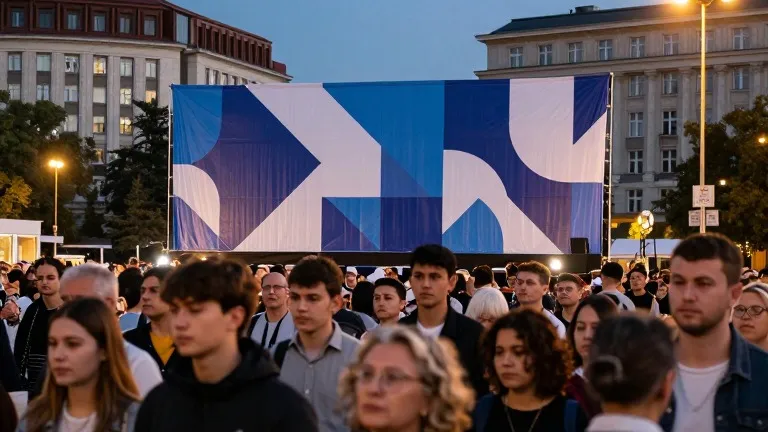
Student List candidates are targeting 40 percent of the vote in Sunday's Serbian parliamentary election, a threshold that would force a political realignment after 14 years of single-party dominance. The group, which emerged from student protests, held its final campaign rally in Belgrade on Thursday evening, drawing thousands of supporters who had traveled across the country to the capital. This mobilization marks the first competitive election since Aleksandar Vucic's Serbian Progressive Party (SNS) took power in 2012, according to political scientist Dusan Spasojevic.
The movement gained momentum after a concrete canopy collapsed at the Novi Sad railway station in November 2024, killing 16 people. Leaders framed the disaster as evidence of institutional failure and used it to rally support against government corruption. Arsa Stojanovic, a biology student, told the Belgrade crowd that the group had crossed Serbia from end to end, visiting villages and neighborhoods to build a base of trust. Aleksandar Cupic, a transport engineering professor and candidate, stated that the atmosphere 'smells like freedom.' The event concluded with a traditional circle dance, a kolo.
The SNS responded by holding a competing rally nearby, emphasizing stability and continuity. Former President Vucic accused opponents of acting on foreign orders and attacking the party with billions of euros. He framed the election as a battle for sovereignty, warning that a change in government risks chaos. This narrative contrasts with the Student List's push to set aside traditional ideological and foreign-policy divisions.
Tensions rose during the campaign as the independent monitoring group CRTA recorded 116 incidents of physical violence or verbal threats by the final week. These incidents included attacks on campaigners and attempts to seize banners. CRTA reported that opposition activists, particularly those linked to the Student List, faced surveillance and police questioning. The group concluded that the campaign was neither free nor fair, noting that nearly three-quarters of national television airtime went to government representatives.
CRTA also found that more than 80 percent of coverage regarding the Student List was negative. The Balkan Investigative Reporting Network published testimony from a former SNS member describing pressure on public-sector employees to deliver votes. Anonymous sources indicated that voters were offered between 30 and 150 euros, or family holiday packages, to support the SNS. Spasojevic noted that while these allegations exist, they may not alter the final result.
Authorities have warned of potential street violence, alleging that students are aided by foreign intelligence services. Several individuals have been arrested on suspicion of plotting disturbances for election night. Spasojevic observed that polls point to a narrow margin, making a post-election crisis likely. He added that a narrow SNS victory would almost certainly be contested, as the movement has vowed to defend every vote.
The European Union plays a key role in the aftermath. An EU Commission spokesperson stated that key recommendations for improving Serbia's electoral framework remain unimplemented. The spokesperson stressed that democracy and the rule of law are central to the accession process, a status Serbia has held since 2012. The EU's response could influence whether authorities accept defeat or respond with heavy-handed measures to protests.
Source: Deutsche Welle
More Politics · World news · Report a business · Got a Story?