Chinese Chipmakers Accept Yield Losses to Bypass EUV Restrictions
Morgan Stanley estimates CXMT produces one-third the bits per wafer as rivals, forcing SMIC and CXMT to pay a premium for older DUV tools.
By Maya Sokolov ·
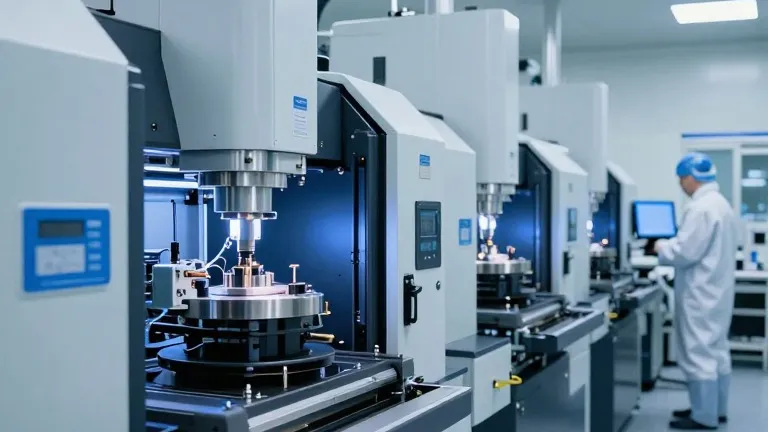
SMIC and CXMT are printing advanced silicon on older deep ultraviolet (DUV) machines, accepting lower yields to sidestep export controls on extreme ultraviolet (EUV) equipment. By splitting critical chip layers into multiple exposure steps, the manufacturers can produce capable processors without ASML's latest tools. The trade-off is a higher cost per wafer and a reduced number of usable dies.
Morgan Stanley estimates CXMT produces roughly one-third as many bits per wafer as its Western competitors. The bank labels lithography access a hard ceiling for Chinese memory development. Each additional exposure step introduces alignment errors, forcing designers to widen the space around features. This enlargement reduces the number of dies per wafer, a costly outcome when individual wafers run tens of thousands of dollars.
Chris Mack, co-founder and CTO of Fractilia, notes that industry standards previously suggested three exposures on a 193 immersion tool cost about the same as one EUV pass. At four masks, EUV becomes the cheaper option. Mack emphasizes that the ability to make a chip without EUV ignores the financial and physical trade-offs involved. He states, You don't sell wafers, you sell die.
SMIC has used DUV to produce the Kirin 9000S and Kirin 9030 processors. Teardowns of the Huawei Mate 60 Pro confirmed the 7nm-class chip was made without EUV. More recent analysis suggests SMIC's DUV process is approaching the density of 5nm manufacturing. However, the process still trails the leading nodes from TSMC and Samsung. Some analysts estimate the technological gap between China and the West is five years or more.
Micron developed its 1-alpha DRAM without EUV, using multiple patterning and tight process control. Mack says the company pushed 193nm technology farther than other memory makers. Morgan Stanley believes CXMT can move to 1-alpha DRAM for HBM3e without EUV. The bank projects CXMT will increase its share of global DRAM bit supply from 14% in 2026 to 16% in 2028 by adding new greenfield capacity.
Mack believes a 3nm or 2nm node is unlikely to be economically viable without EUV. He notes that EUV has its own drawbacks, including stochastic effects that require higher exposure doses. Still, the cost of extra DUV masks outweighs the savings from avoiding EUV at the leading edge. China's AI chip self-sufficiency is expected to rise from 42% in 2025 to 70% by 2030, while gaps in EUV and advanced software persist.
Source: Tom's Hardware