Physicists Limit Dark Matter Black Holes to 100 Billion Solar Masses
Analysis of the cosmic microwave background indicates that black holes heavier than this threshold cannot constitute a major portion of the universe's missing mass.
By Maya Sokolov ·
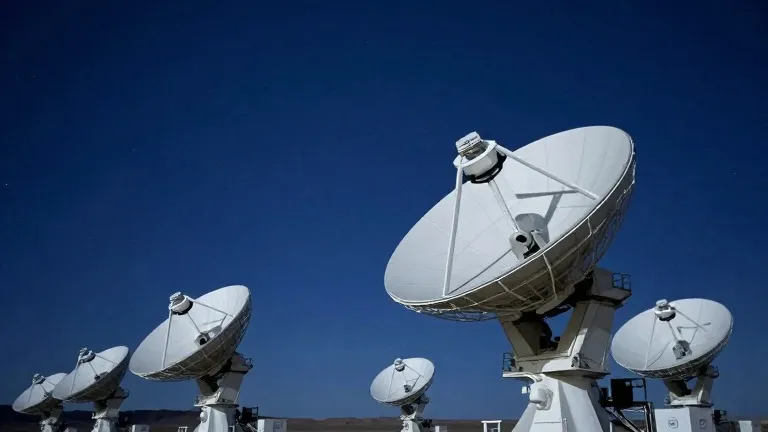
A new analysis suggests that black holes exceeding 100 billion solar masses cannot make up a large share of dark matter. The finding narrows the search for the invisible substance that holds galaxies together. It confirms that the universe's missing mass is not concentrated in a few massive, galaxy-sized objects.
The research team examined the cosmic microwave background, the oldest light in the universe. This radiation was released 380,000 years after the Big Bang when the cosmos cooled enough for light to travel freely. Christopher Gerlach, a theoretical physicist at the Mainz Institute for Theoretical Physics in Germany, described this light as a snapshot of the infant universe covering the whole sky. He noted that dark matter is often pictured as a fine dust spread everywhere, but if it were clumped in gigantic objects, the universe would appear grainy on large scales.
The team looked for that graininess in the background's temperature patterns. Antonio Iovino, a theoretical physicist at New York University Abu Dhabi, explained that the background's temperature varies from place to place by about one part in 100,000. These variations reveal how matter was distributed in the early universe. The analysis showed that the background lacks the specific fluctuations that would be produced by stupendously large black holes, which are defined in the study as objects with more than 100 billion times the mass of the sun.
The results indicate that black holes in this massive range are not a primary component of dark matter. Nicholas Leister, also at the Mainz Institute, stated that these black holes cannot be a significant part of the dark matter. The study does not rule out the existence of such objects entirely, but it limits their contribution to the total matter budget of the cosmos. The largest black hole currently known weighs about 36 billion solar masses, placing it well below the new upper limit.
Dark matter was proposed to explain why galaxies do not fly apart given their rotation speeds. It is estimated to account for about five-sixths of all matter in the universe. While its exact nature remains unknown, it is believed to exert gravitational pull that holds galactic structures intact. Black holes have been considered a candidate because they are massive and difficult to detect in the darkness of space. The current study addresses the possibility that the missing mass is concentrated in these extreme objects.
The researchers noted that their findings do not eliminate all black hole candidates. They are now examining whether relatively tiny black holes, about the size of asteroids, might still be a major constituent of dark matter. The study provides a clearer boundary for theoretical models of the universe's composition. It shifts focus away from galaxy-mass objects and toward other potential sources of the invisible mass.
Source: Space.com