Three bright trails mark Halley debris over Toccoa
Astrophotographer Tim McCollum logged three meteors in a 30-minute window before the Orionid shower reaches its peak activity.
By Kaito Shevchenko ·
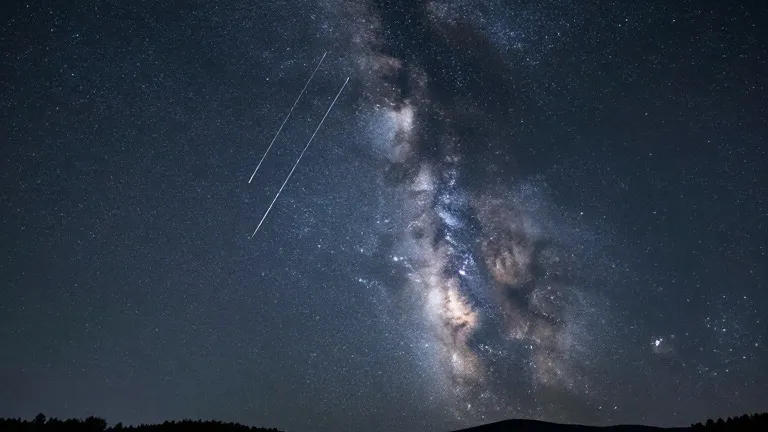
Tim McCollum recorded three distinct meteor trails over Toccoa, Georgia, between 3 a.m. and 4 a.m. on Oct. 21. The streaks originated from debris associated with Comet 1P/Halley, which is currently more than 3 billion miles from Earth. The particles created visible glowing paths despite the comet's vast distance.
The capture required specific equipment and timing. McCollum used a Canon EOS Ra camera paired with an RF 28-70 f2.0 lens. He set the camera to take multiple 30-second exposures while a star tracker kept the device pointed at the shower's radiant. This point of origin lies near the red giant star Betelgeuse in the constellation Orion.
McCollum merged the individual frames into a single composite image using PixInsight software. The final frame displays the three meteors racing away from the radiant. The image also contains Orion's Belt and the Orion Nebula on the right side. The Rosette Nebula, catalogued as Caldwell 49, appears within the dense starfield of the Milky Way's galactic plane, which runs diagonally across the photo.
The Orionid meteor shower builds toward peak activity in the coming days. The annual display will remain active until Nov. 7. McCollum noted that capturing such events depends on skill, luck, and patience. The specific timing of the three bright trails allowed him to document the debris field before the shower's maximum output.
Observers have additional options for viewing meteor activity this week. Earth is currently passing through debris streams from Comet 2P/Encke. This stream produces the Taurid meteor shower, which can occasionally generate bright fireballs. These events may coincide with the Orionid activity in the night sky.
The next major window for viewing the Orionids is expected to occur as the shower reaches its peak. The debris from Halley's Comet continues to burn up in the atmosphere at high speeds. The specific capture in Toccoa serves as a record of the shower's intensity ahead of its highest activity period.
Source: Space.com