Moon Cities May Run Out of Water Before They Run Out of Power
New research indicates that lunar water reserves are likely insufficient to support large-scale settlements for long periods, challenging ambitious space colonization timelines.
By Kaito Shevchenko ·
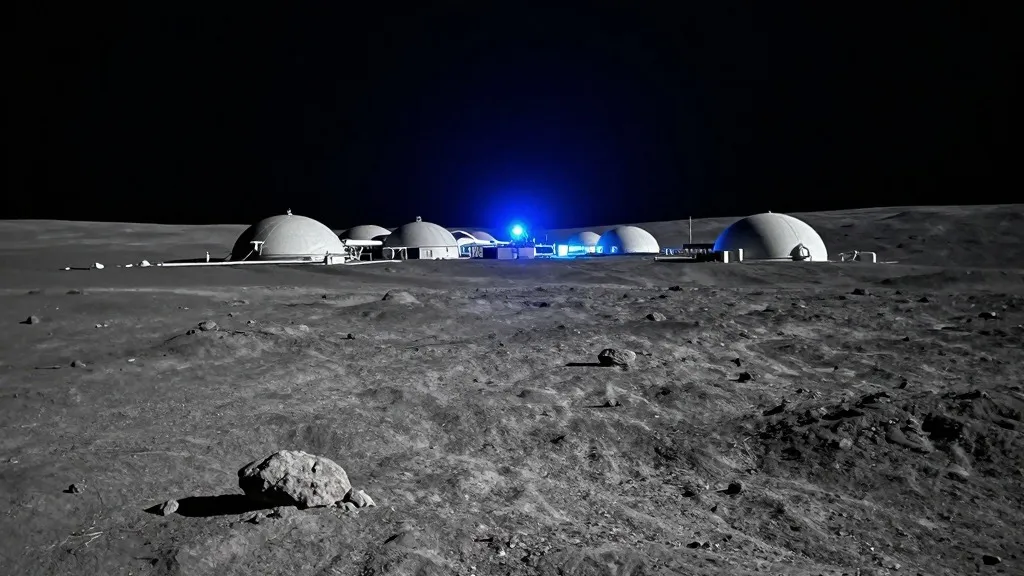
The race to build permanent human habitats on the moon faces a critical bottleneck that has nothing to do with rockets or habitats. While power generation appears solvable with current technology, the availability of water poses a severe constraint on how large a lunar city can grow and how long it can survive. This tension between ambitious engineering goals and limited natural resources is at the heart of a new study published in Frontiers in Space Technologies.
The first key point is that power is not the limiting factor. Researchers Martin Elvis of the Smithsonian Astrophysical Observatory and Jonathan McDowell of Durham University determined that solar and nuclear energy sources are sufficient to sustain a population of one million people. This finding clears a major hurdle that has previously complicated long-term planning for lunar infrastructure.
The second key point is that water reserves are far smaller than the population targets suggest. Current estimates place the total amount of water on the moon at roughly one billion tonnes, mostly located in permanently shadowed polar regions. Under the assumption that 98% of water can be recycled, a million-person settlement would exhaust its supply in approximately 100 years. A smaller community of 10,000 people, however, could sustain itself for centuries under the same conditions.
The third key point is that the initial water estimates may be overly optimistic. Elvis suggests the one billion tonne figure could be 20 or 30 times too high. He estimates that only about one percent of that total is realistically recoverable. If this lower figure holds true, the lifespan of a million-person city would drop from a century to a single year, drastically changing the economic and logistical calculations for developers.
Context for these findings comes from high-profile claims by industry leaders. In February, SpaceX CEO Elon Musk stated the company is focusing on a self-growing lunar city within ten years, while Blue Origin CEO Jeff Bezos predicted millions of people would live in space by 2045. These timelines rely on the assumption that essential resources are abundant and accessible, a premise the new data challenges. The physical form of the water also presents engineering difficulties. Gordon Osinski of Western University notes that satellite data is uncertain and the water may exist as tiny ice crystals mixed into soil, similar to Arctic permafrost, making extraction difficult.
The outlook remains cautious but not pessimistic. The researchers argue that knowing the limits is better than guessing. McDowell noted that attempting to build something that does not work is the real negative. For investors and engineers, the focus must now shift from simply landing people on the moon to solving the complex problem of water extraction and recycling at scale.
Source: CBC News
More Business · World news · Business Complaints · Report a business · Got a Story?