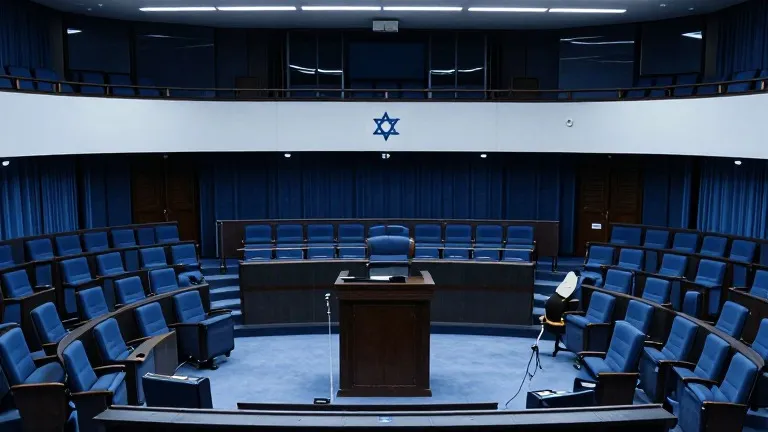
Eisenkot Challenges Netanyahu in 120-Seat Israeli Knesset Race
Polls show a tight split between pro and anti-Netanyahu blocs as voters head to the polls Tuesday.
By Maya Sokolov ·

Israeli voters cast ballots on Tuesday in a contest that divides the electorate primarily along lines of support for Benjamin Netanyahu rather than traditional left-right ideology. Netanyahu has served as prime minister for 19 of the last 30 years, and current polls indicate a narrow margin between the factions aligned with him and those opposed to his leadership.
The leading opposition challenger is Gadi Eisenkot, a former head of the Israel Defense Forces who entered politics four years ago. His party, Yashar, operates on the principle of directness, and Eisenkot proposes term limits for prime ministers to limit the concentration of power. At a recent rally in Modi'in, supporters praised his plain speaking style as a contrast to traditional political rhetoric.
The anti-Netanyahu coalition includes former prime minister Naftali Bennett and Avigdor Lieberman, both of whom previously served in Netanyahu's government. On the right, Itamar Ben-Gvir's Otzma Yehudit party argues that Netanyahu has drifted left. Yishai Fleisher, a party spokesperson in Bet Shemesh, advocated for more West Bank settlements, a ministry to manage Palestinian departure, and expanded weapons access for Jewish civilians.
Netanyahu's campaign strategy frames the choice between the right and Palestine. His posters pair opposition leaders with representatives of the two parties for Palestinian citizens, who constitute approximately one-fifth of the population. Pro-Netanyahu media, including Channel 14, have pressured opposition figures, with one host recently using a derogatory term for Eisenkot that was later repeated at a rally.
The race follows a period of significant domestic and international strain for the incumbent. The October 7, 2023 attacks occurred under his watch, and the subsequent war in Gaza resulted in the deaths of more than 70,000 Palestinians. Israel states that one-third of those killed were Hamas combatants, but the group remains active. Netanyahu also faces a corruption trial and the political fallout from his attempts to reform the supreme court.
Despite these challenges, Netanyahu retains a loyal base that credits him with maintaining stability. His supporters argue that military and intelligence chiefs shielded him from warnings before the October 7 attacks, a claim his allies say is unfounded. Many political observers expect him to use his experience in coalition building to secure a majority during post-election negotiations.
Opposition strategies rely partly on the return of secular Israelis living abroad to vote in person. This demographic is not fully captured by standard polling and could influence the outcome if the result hinges on a single seat in the 120-member Knesset. Former general Yair Golan, leader of the Democrats party, expressed optimism about forming a government that focuses on long-term regional security.
The election takes place shortly after a state ceremony commemorating the 1995 assassination of Yitzhak Rabin, an event Netanyahu did not attend. A viral video of young Israelis singing a Rabin-era song at a Negev festival has been interpreted by some as a sign of shifting public sentiment, though the final seat count will determine who forms the next government.
Source: The Guardian
More Politics · World news · Report a business · Got a Story?