Hollywood Execs Urge Japan to Simplify Film Funding Rules
Producers argue that automatic approval and clearer criteria are needed to retain international shoots as Tokyo prepares a unified content agency.
By Kaito Shevchenko ·
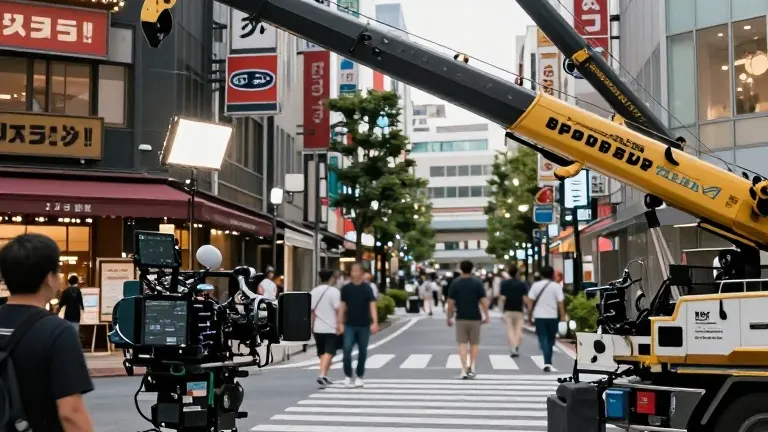
Executives from major global studios are pressing the Japanese government to remove subjective hurdles from its film incentive program. Speaking at the Motion Picture Association's annual seminar during the Tokyo International Film Festival this week, industry leaders argued that current approval processes create too much uncertainty for international productions. They called for an automatic system that guarantees funding based on clear spending thresholds rather than panel decisions.
The calls for change coincide with a major administrative shift in Tokyo. The government is establishing a new unified body to consolidate content-industry support, which is currently fragmented across four different ministries. This new entity, ordered by the Prime Minister, is designed to break down bureaucratic barriers and streamline policy for the creative sector.
Producer Alex Boden, who spent nearly two years in Japan producing two seasons of HBO Max's "Tokyo Vice," detailed the evolution of the incentive scheme. He noted that the program began as a 2020 research initiative, moved to the 2023 J-LOD incentive, and is now known as IP360. Under current rules, productions receive a 50% rebate on Japanese spending. However, Boden argued that the minimum spend requirement, recently raised to 800 million yen or roughly 5.1 million dollars, effectively excludes independent films. He cited the average cost of a Japanese film, which ranges between 1.5 million and 3 million dollars, as evidence that the current threshold is too high for many local projects.
Boden questioned how producers can rely on the incentive when projects take three to five years to develop. He pointed to high-profile titles like Martin Scorsese's "Silence" and the series "Pachinko" and "Shogun," which scouted locations in Japan but ultimately filmed elsewhere due to logistical and financial uncertainties. To address this, he suggested adopting a model similar to the U.K.'s ScreenSkills levy, which uses a small percentage of budgets for training.
Deb Richards, Netflix's production policy director, echoed the need for transparency. She stated that certainty is more valuable than the size of the rebate. Richards described the current selection process as opaque, noting that applicants often cannot understand why they were rejected unless they compare their cases to approved projects. Paul Muller, the MPA's VP of production policy for Asia-Pacific, highlighted that METI is currently moving from single-year to two-year financing structures and raising maximum thresholds, a shift he welcomed.
On the government side, Nakahara Hirohiko, director-general of the Cabinet Office's Intellectual Property Strategy Promotion Secretariat, confirmed that a task force for the new entity met for the first time on Oct. 22. The agency is scheduled to launch in 2027. It will oversee a public-private investment roadmap that targets 20 trillion yen, or 127 billion dollars, in overseas sales by 2033. The plan aims to position Japan as a global hub for film production by attracting large-scale shoots and backing international co-productions.
Georgina Pope, head of production at Toho Tombo Pictures, noted that while permitting in Tokyo remains challenging, the situation is improving. Her team recently closed the road in front of Tokyo City Hall for a scene in A24's "Marty Supreme." Boden concluded by warning that if the government does not act quickly to simplify the incentive, Japan risks missing a prime window to capture more of the global production market.
Source: Variety
More Business · National news · Business Complaints · Report a business · Got a Story?